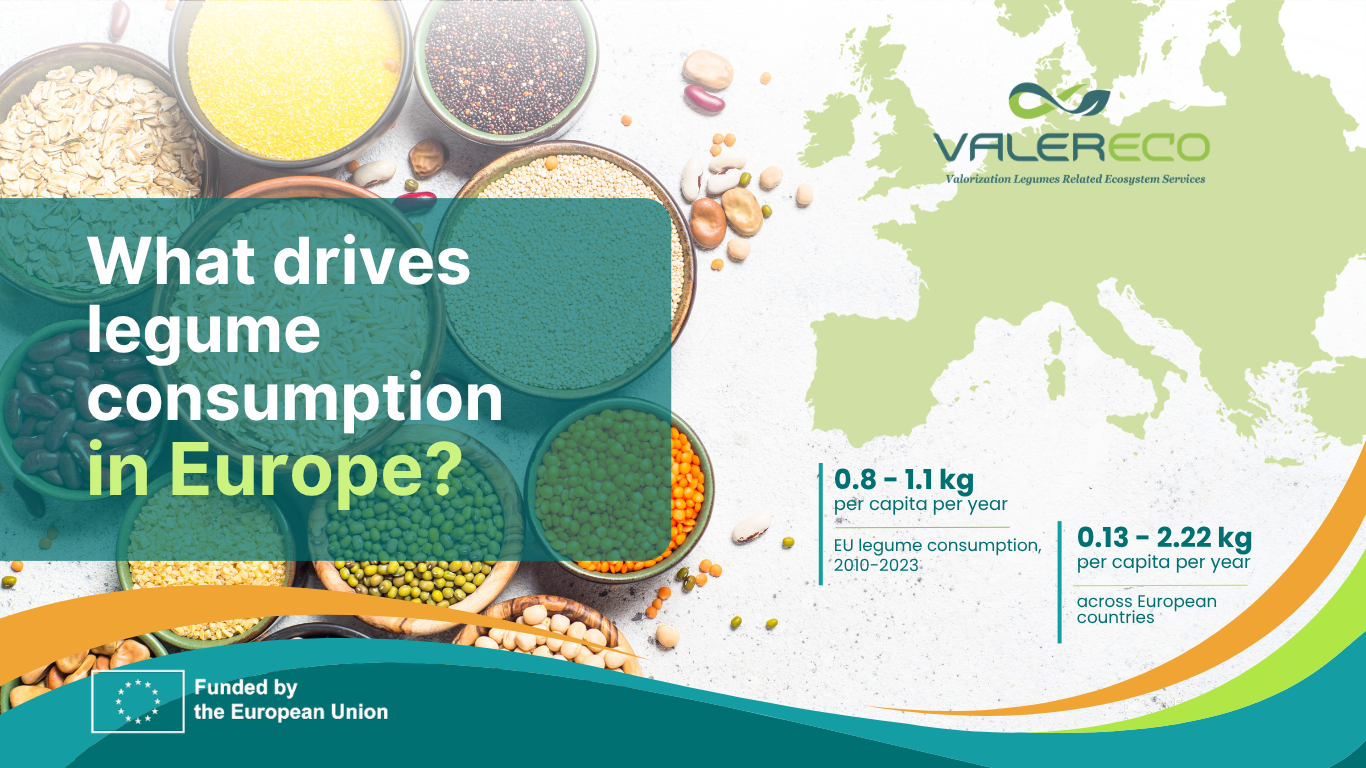
A new VALERECO White Paper developed by the BioSense Institute (BSB), drawing on FAOSTAT data for 2010–2023, explores why legume consumption in Europe remains low and differs substantially across countries.
Legumes have many of the characteristics associated with the transition towards more sustainable diets. They are nutritious and affordable, require relatively little water, contribute to soil health through nitrogen fixation and have a long shelf life that can help reduce food waste. Yet their advantages have not translated into a substantial change in European consumption. EU data for 2010–2023 reveal a remarkably persistent pattern. Annual legume consumption fluctuated between approximately 0.8 and 1.1 kg per capita, remaining relatively low throughout the period. There were fluctuations from year to year, but no strong structural transformation in consumption over more than a decade. This persistence is particularly interesting from a behavioural perspective. If legumes are increasingly promoted for their nutritional and environmental benefits, why do they still occupy such a limited position in European diets?
The European average hides a much more complex picture
Looking only at the EU-wide trend can be misleading. Country-level data reveal substantial geographical heterogeneity, with legume consumption ranging from approximately 0.13 to 2.22 kg per capita. At the upper end, Lithuania, Spain and Estonia exceed 1.8 kg per capita per year, while Germany, Croatia and Latvia record substantially lower levels. A broader regional pattern is also visible: Southern European countries such as Spain, Italy, Greece and Portugal generally show higher consumption, while levels tend to be lower in Northern and some Western European countries. These differences matter because they suggest that legume consumption cannot be understood through a single European pattern. The persistence of national and regional differences directs attention towards the factors shaping food choices in different contexts.
Price and availability explain only part of the picture
Economic factors are an obvious starting point. Income, price and food availability all influence what people eat. But they do not fully account for the wide differences in legume consumption observed across European countries. Food choices are also embedded in culture. Shared values, social norms, traditions and long-established eating habits can influence what becomes part of an everyday diet. The contrast is visible in European dietary traditions: legumes and olive oil have a central place in the Mediterranean diet, while potatoes and meat have traditionally played a larger role in many Northern European diets. This cultural dimension opens an important research question. Previous studies have linked cultural values to food-related behaviours including alcohol and wine consumption, overall dietary patterns and sustainable consumption. Far less is known, however, about how cultural values may explain cross-country differences specifically in legume consumption. Understanding this relationship could help explain why populations respond differently to the transition towards more sustainable diets.
The challenge is not simply informing consumers
The stability of consumption over the 2010–2023 period also points to the persistence of dietary habits. Changes in such habits require long transition periods, meaning that greater recognition of the benefits of legumes does not necessarily lead to rapid changes in what people eat. This shifts the discussion from simply identifying the benefits of legumes to understanding how food choices can change. Informational campaigns and direct or indirect nutritional education can contribute to the uptake of legume-based diets. Behavioural approaches provide another tool. Within VALERECO, behavioural interventions, or “nudges”, are being developed and tested to encourage healthier and more sustainable dietary choices. The underlying principle is important: effective strategies depend on understanding the factors that influence consumers’ decisions. Behavioural interventions can therefore complement agricultural and market policies, addressing the consumption side of the transition alongside wider efforts to support legumes.
From consumption data to behavioural insight
The European data reveal more than simply low consumption. They show persistence over time and pronounced variation across countries. Together, these two characteristics make consumer behaviour and cultural context particularly relevant to understanding why the role of legumes in European diets remains limited. Exploring what lies behind these differences can help move the discussion beyond the question of whether Europeans should consume more legumes towards the more complex question of what can actually support lasting changes in dietary behaviour.
Interested in exploring the data and analysis in more detail?
Read the full VALERECO White Paper, Understanding Legume Consumption in Europe: Consumer Behaviour, Cultural Factors and Pathways to Sustainable Diets, here: https://valereco.eu/…/upl…/2026/10/White_Paper_BSB-1.pdf
Comments are closed