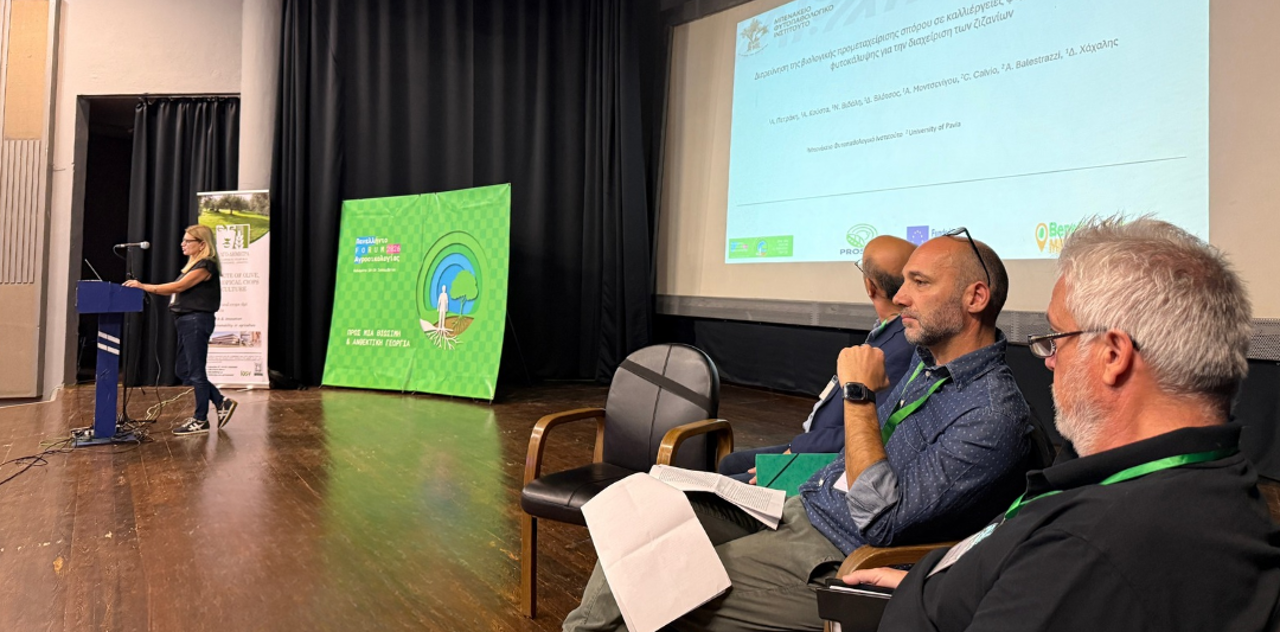
How can legumes help farmers manage weeds while supporting more sustainable agricultural practices? This was among the questions explored through VALERECO research presented at the 1st Greek Agroecology Forum, held in Kalamata, Greece, from 24 to 26 September 2026.
The Forum brought together researchers, farmers, agricultural professionals and other stakeholders to exchange knowledge and explore practical approaches to building more sustainable, resilient and environmentally responsible agricultural systems. Designed as a platform for dialogue between science and practice, the event highlighted the importance of collaboration in advancing agroecology in Greece.
Sharing VALERECO research and findings
The Agricultural University of Athens (AUA) represented VALERECO through an oral presentation in Session 5, New Trends in Agroecological Crop and Weed Management.
Legumes start growing slowly and do not compete well with weeds. Weeds can cause significant yield losses, so weed control really matters. The presentation focused on research conducted within VALERECO to assess agroecological crop-weed management practices in two winter legumes, specifically lentil (Lens culinaris Medik) and sulla (Sulla coronaria L.).
The research involved field experiments carried out in Central Greece during 2024–2025, comparing different crop and weed management approaches. The trial compared five crop/weed management treatments across seven crop rotations based on lentil, sulla and wheat: an untreated control, mechanical weed control, intercropping, cover crop mixture, and the cover crop mixture combined with mechanical control..
Overall, the results showed that combining complementary practices is more effective than relying on a single one. The combination of a cover crop and mechanical weed control provided the best weed suppression in all crops, as the cover crop limits weed emergence early in the season and mechanical control addresses weeds at later stages. Legumes were less competitive than wheat, and the most suitable approach varied by crop: in sulla a single practice was often sufficient, whereas lentil required a combination of practices. Improved weed control also had a positive effect on crop yield and quality.
Connecting research with practical solutions
These findings directly support VALERECO’s wider mission to enhance the use of ecosystem services in diversified cropping systems.
Through its network of nine Living Labs across six European countries, VALERECO brings together researchers, farmers and other stakeholders to explore and evaluate agricultural practices adapted to local conditions.
The Greek research on lentil and sulla contributes to this collaborative effort by generating evidence on how crop diversification and complementary weed management practices can help reduce dependence on external inputs and support more sustainable farming systems.
Participation in the Greek Agroecology Forum provided an opportunity to share these insights with the wider agroecology community, encouraging dialogue between scientific research and agricultural practice.
By connecting experimental findings with real-world farming challenges, VALERECO continues to contribute to the development of more resilient and sustainable European agriculture.
Comments are closed